



Many shooters view the .223 and 5.56 as identical or at least interchangeable rounds. Well, listed case dimensions are the same, and each will chamber in barrels bored for the other. But that’s not the full story.
Hornady engineers tell me the .223 Remington is stoked to 55,400 CUP (Copper Units of Pressure), a level specified by SAAMI (the Sporting Arms and Ammunition Manufacturers Institute). Service loads for the 5.56×45 NATO generate 58,500. Chamber dimensions and rifling twist vary among the myriad AR-15s and bolt rifles barreled to .223, but the 5.56 commonly gets a longer throat. “Roughly .125 more freebore,” say the white-coats bearing micrometers.
Can You Shoot .223 in a 5.56 Rifle?
It is generally accepted that commercial .223 Rem ammunition like the Norma Tactical .223 can be safely shot in any firearm chambered for the 5.56 NATO cartridge. However, given common differences in loads and throats, it’s a good idea not to use 5.56mm ammo in a firearm with a dedicated .223 chamber.
In 1979, SAAMI cautioned that 5.56 chambers differ from those in .223 sporting rifles, and that use of 5.56 ammo in .223 rifles could jack pressures to unsafe levels. The reverse — .223 in a 5.56 chamber — doesn’t have the same pressure concerns.
So what does that mean for your firearm?
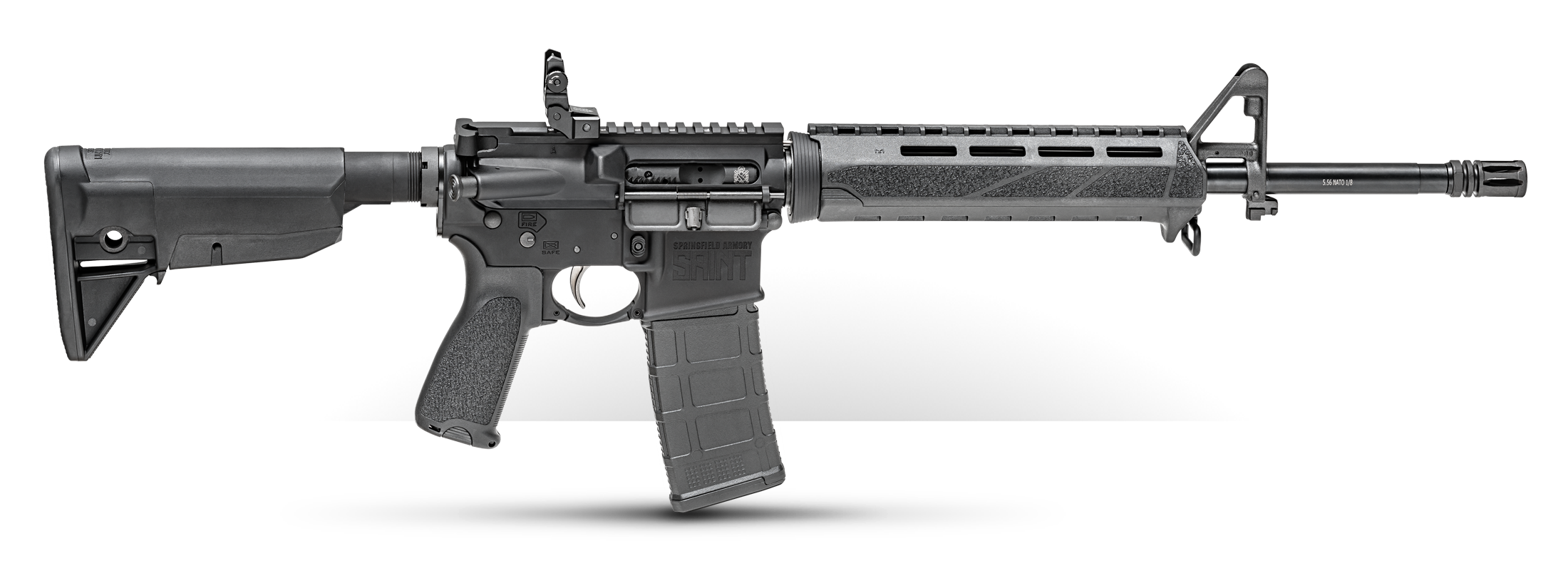
In the case of Springfield Armory’s SAINT .22-bore rifles and pistols, they are described as “multi-caliber”, meaning they’re designed to function well and safely with both .223 and 5.56mm rounds.
.223 vs. 5.56: Fraternal or Identical?
The lineage of these enigmatic twins dates to 1957, when the .223 popped up as an experimental cartridge for what would become the M16 infantry rifle. Working with Gene Stoner, Bob Hutton at Guns & Ammo magazine paired a 55-gr. bullet with a case a tad longer than a .222’s cartridge case. The tiny missile exited at 3,250 fps and met a retained-velocity spec of supersonic flight to 500 yards.
Adopted in 1964 as the 5.56mm Ball cartridge, M193, it was issued to U.S. forces in Vietnam, and after that tour until 1984. In 1980 it earned the approval of NATO nations, which substituted an FN-designed 62-grain SS109 boat-tail bullet. The SS109 left the gate at 3,100 fps. Its superior ballistic coefficient ensured harder hits at distance. Faster 1-in-7 rifling twist maintained accuracy. The U.S. Army called this load the M855. By then, case length in millimeters had joined the moniker. So was born the 5.56×45 NATO.
It was soon recognized that the round had a lot of merit for use in sporting rifles. Naturally. The .223’s design owed much to the popularity of the .222 Remington round that had been introduced in 1950. The “triple deuce” cleaned up at Benchrest meets and bumped pelt counts for fox hunters. The .223’s 1.76″ case is just .06 longer than the .222’s. But the .223 has a shorter neck and holds 20 percent more powder.
As rifles and loads were developed for the new .223 round, a shorter throat and steeper leade (ramp angle of the lands in front of the throat) was employed. A tiny rodent behind the crosswire demanded fine accuracy not required on the battlefield. An infantry rifle’s priority was function, often in trying conditions hunters didn’t endure. No matter the weather, the grit and debris and egg-cooking barrel temperatures, perhaps long-nose tracer bullets awaiting their chance to jam, a soldier needed the bang!
As a result, M16s got generous chambers. Bolt-action rifles enjoyed tighter tolerances, shorter bullet jump and slower 1-in-12 rifling for popular 40- to 55-gr. varmint bullets. But, today’s AR’s in the civilian market have proven to be extremely capable of impressive accuracy as well.
No Looking Back
The .223 has piled up a mountain of commercial loads as compared to relatively few of the 5.56 NATO. Winchester alone lists 18! Remington has 13. So does Hornady, from a 35-gr. NTX bullet at 3,760 fps to a 75-gr. Superformance Match BTHP at 2,930. Federal catalogs a dozen .223 loads, including a 60-gr. Nosler Partition at 3,160 fps and a 62-gr. Trophy Bonded Tip at 3,050. Swift loads a 75-gr. Scirocco. Black Hills Ammunition rips tons of ballistic gelatin refining .223 loads (15) and 5.56 (8), as it supplies U.S. troops with mil-spec 5.56.
The .223’s credentials on prairie dogs and coyotes hardly need defending. But where it’s legal for deer, hunters debate. Two-two-three acolytes dig out ballistics charts. “The .44-40 has laid low countless deer with 200-gr. bullets that bring 450 ft-lbs to 100 yards. Winchester’s 64-gr.Power-Point — hardly the frothiest .223 load — delivers 1,000 ft-lbs there and trumps the bullet weight/animal weight and bullet energy/animal weight ratios of 175-gr. 7mm Magnum bullets on elk!” The advent of stoutly built .22 game bullets like Remington’s Core-Lokt Ultra Bonded, Nosler’s Partition, Hornady’s GMX and Swift’s Scirocco argue in favor of the .223’s use on deer.
A counterpoint: Bullet weight and diameter bow to velocity in energy calculations, but can figure heavily in killing effect. Arguably, precise shot placement matters most with small bullets.
The wide range of .223 loads begs sifting before you specify rifling twist. Nosler advises a 1-in-12 spin for bullets no longer than its 60-grain Partition. In my tests, 1-in-12 bores kept groups tight with bullets as heavy as 62 grains but spun 69-grain BTHPs too slowly. A 1-in-8 spin is claimed to stabilize BTHPs to 80 grains, and shoot bullets as light as 50 grains accurately. As always, test out your preferred load in your gun to check results.
Conclusion
So there you have it, the story of the .223 vs. 5.56, going back to the birth of the 5.56mm M16 all the way up to today’s top .223 loads. Obviously, the round and the AR combo is one of the most popular in American today, due in no small part to the exceptional performance of both.
Much like the 7.62 and .308 rounds, there is sometimes confusion over what each cartridge designation means. Are they the same, or are there significant differences.
The .223 has grown beyond its M16 roots to become a popular round for other platforms such as bolt-actions and more. And now you know what you can shoot in which!
Editor’s Note: Please be sure to check out The Armory Life Forum, where you can comment about our daily articles, as well as just talk guns and gear. Click the “Go To Forum Thread” link below to jump in and discuss this article and much more!
Join the Discussion
Featured in this article
Read the full article here