




On the morning the regime fell, Rashid Saad left his house before dawn and stepped onto the road outside Al-Rusafa, a village in Syria’s Alawite heartland along the Mediterranean coast. Cars clogged the road in every direction, overloaded with people and their belongings.
It was bitterly cold, but that is not what he remembers most. “There was a kind of fear,” he said. “Of something unknown.”
Life in the village had never been easy. Rashid was poor, and work was hard to find. But under Bashar al-Assad, Alawites like him didn’t worry for their safety. “That was what mattered most,” he said.
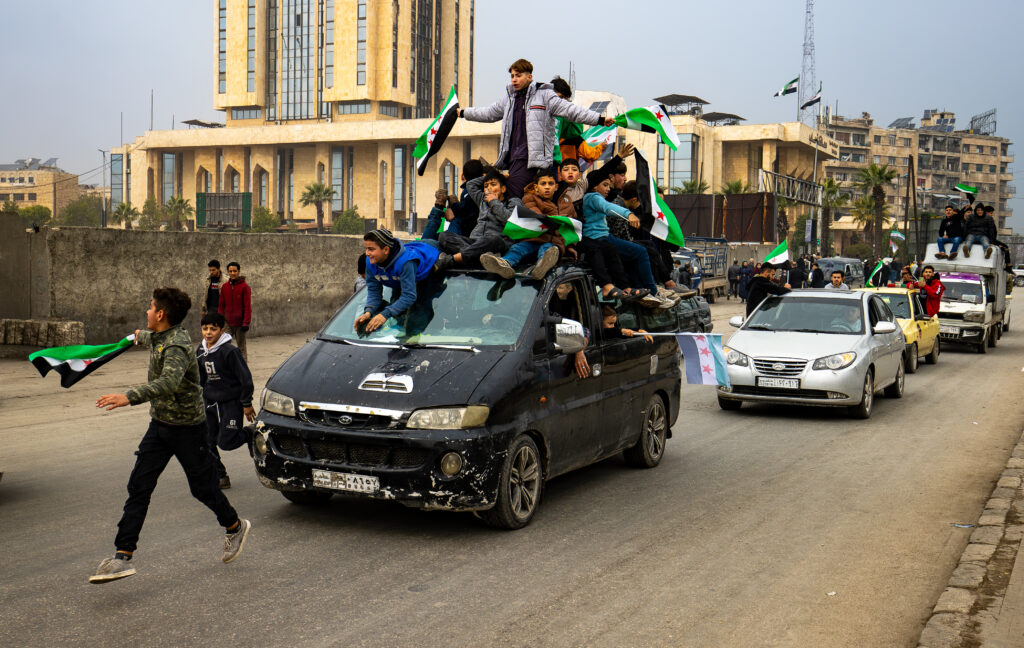
In Damascus and across much of Syria, the collapse of Assad’s government in December 2024 was greeted as liberation. After 13 years of civil war and more than half a century of Assad family rule, the regime’s fall offered a chance to rebuild a country long defined by repression, war, and economic crisis.
In the year that followed, some of that optimism appeared justified. More than a million Syrian refugees returned. Political prisoners were freed. Checkpoints that had strangled movement for years came down. Journalists began to criticize the new government. Western governments lifted sanctions and moved to engage with Syria’s new leadership. Syria’s interim president, Ahmed al-Sharaa, assured the United Nations that his government was creating “a state for all its citizens.”
For Syria’s minorities, however, the transition brought uncertainty. Al-Sharaa, previously known as Abu Mohammad al-Jolani, had led Al Qaeda’s affiliate in Syria—a jihadist movement with a history of targeting non-Sunni communities. Christians, Druze, Kurds, and others watched cautiously, unsure what an Islamist-led government would mean for them. But for the Alawites—the sect from which the Assad family emerged—the question was more urgent: When power changes hands after decades, what becomes of the community once closest to it?
For Rashid, the answer came quickly. Within weeks, stories began to arrive from Damascus, Homs, and Aleppo—of kidnappings, killings, and public humiliations.
Three months later, the violence reached Al-Rusafa. Over two days, armed men moved house to house, killing civilians, looting what they could, and burning the rest. “It was a battlefield,” Rashid told me.
On Friday, they came for Rashid’s eldest son, Suleiman, 26. Ten men entered the house, singled him out, and took him away. “This one is for slaughter,” Rashid recalled them saying.
Rashid later found Suleiman’s body on the road. His heart had been cut from his chest. Four of Suleiman’s cousins were also killed in the attacks.
“They killed him for no reason,” Rashid said. “Only because of the label—his identity, his sect.”
The killings came as violence spread through Alawite communities along Syria’s Mediterranean coast. Former regime soldiers and Alawite militiamen had launched a brief uprising against the new authorities. The rebellion was quickly crushed, but in its aftermath, reprisals swept across Alawite villages. Reuters estimated that nearly 1,500 Alawites were killed and dozens went missing.
Rashid said he heard little outrage beyond the Alawite community. “Any normal person should condemn this,” he said. “But there was silence.”
“It’s clear this was intentional,” he continued. “What do they call it—collective punishment? Or, if you want to use the precise term, ethnic cleansing. Because when you are an Alawite, that’s all that matters.”
Violence against Alawites took many forms. Activists have documented numerous kidnappings, including children abducted on their way to school and women taken without ransom demands.
One father whose son was kidnapped described the lasting impact. “Being an Alawite means something different now,” he told me. “Now we feel like fifth-class citizens—10th-class.” His family paid for the boy’s release and is now searching for a way out of Syria.
“They say for 10 years we were killing, raping, slaughtering,” he continued. “Assad’s people committed those crimes. Let them take their revenge on Bashar al-Assad, not on us.”
The crimes were real. The Assad regime imprisoned tens of thousands in detention centers like Sednaya prison, where torture was systematic. Security forces fired on peaceful protesters in 2011, igniting a civil war that killed hundreds of thousands. Barrel bombs flattened opposition neighborhoods. Chemical weapons were deployed against civilians.
Syria is now governed by Hay’at Tahrir al-Sham, the former insurgent coalition led by Sharaa. While the new leadership has consolidated power in Damascus, it has struggled, or declined, to discipline armed factions accused of retaliatory violence in Alawite areas. Officials insist that sectarian attacks are the work of rogue actors. Many Alawites, however, say the absence of arrests or prosecutions has eroded confidence that the state is either willing or able to restrain its own allies.
A May survey by Etana found that only 21 percent of Alawites said they felt safe under the current authorities, compared with 85 percent of Sunnis.
In today’s Syria, guilt is often assigned by birth rather than by action. Hassan Ahmad knows this better than most.
Hassan, an Alawite activist from Tartous, began opposing the Assad regime as a teenager—a stance that eventually led to his arrest. He was detained, beaten, and disappeared into the prison system for months.
After his release, he learned that his father had died while he was in detention.
The regime’s collapse brought brief hope. It faded quickly. As reports of killings and disappearances in Alawite areas spread, Hassan began recording testimony and pressing for accountability—work that has brought him death threats.
“My problem is not Sunni or Alawite,” he said. “My problem is any government that kills the Syrian people, starves them, and steals their money and lives.”
Hassan’s work has become harder as the climate has shifted. With press restrictions loosened, social media has filled not just with political criticism but also with sectarian incitement. Islamist accounts openly call for revenge against Alawites and other minorities. The new authorities have largely declined to police hate speech—a silence many Alawites interpret as tacit approval.
In Syria, the collapse of the Assad regime did more than topple a government; it unsettled a social order that had bound one minority to the machinery of the state for more than 50 years. Alawites were never a monolith. Many, like Rashid, were poor. Some, like Hassan, opposed the regime. But many staffed the security services that enforced it. Though only about 10 percent of the population, Alawites dominated the officer corps and elite units and were overrepresented in the state bureaucracy.
For many Sunnis, the violence that followed is seen less as sectarian hatred than as a delayed reckoning for decades of brutality. The regime’s prisons, repression, and chemical attacks were not abstractions; they were lived experience. In that context, anger hardened into a simple equation: Alawite meant loyalist; loyalist meant complicit.
Yet that logic carries its own risk. If a community that once stood close to the state comes to feel collectively punished or politically disposable, the transition risks entrenching new divisions rather than building a new national order.
Officials have established reconciliation committees offering amnesties and financial support to former fighters. But for many Alawites, material gestures cannot address the fundamental question: whether they have a place in the new Syria at all.
Many have concluded that they do not.
Tens of thousands of Alawites have fled across the border to Lebanon’s Bekaa Valley, where many now live in informal settlements. In a cramped apartment in Baalbek, I sat with more than a dozen Alawite refugees as they described what drove them out and why they cannot return.
On the morning the massacres began, Lina, a pseudonym for a young woman from Jableh, started destroying anything that tied her family to the old regime. Her father had left the military in 2005, but that would not matter now. “We burned his pictures, our books—anything that showed we were Alawites,” she said.
By 6 a.m., they heard people shouting “Allahu Akbar” in the streets. Days earlier, at a supermarket, armed men had confronted her brother and asked whether he was Alawite. When he said yes, they told him: “Prepare yourself to be slaughtered, and your sisters to be slaves.”
The threats soon became reality. Over two days, armed men moved through their neighborhood, killing residents and burning homes. In June, Lina and her family fled to Lebanon with thousands of others.
For some Alawites, the violence continued even after attempts at reconciliation. Hundreds of soldiers stationed in Iraq when Assad fell returned to Syria after the new government promised they would not be punished. Instead, they were detained at the border. Security forces beat them with iron rods, forced them to crawl through gantlets of men wielding sticks, and crammed them into cells without showers for two months. They were made to bark like dogs and threatened with execution daily.
“Al-Sharaa said he wouldn’t punish us,” one former soldier told me in Baalbek. “But they took everything—our phones, our money, our clothes. They beat us for hours.”
In Lebanon, the refugees face a different kind of precarity. Without legal status, they cannot work formally or move freely. Employers pay them a fraction of normal wages. “No one cares about you,” Lina said. “You’re alone. No organizations, no charities. The whole world is watching, but no one says anything about us.”
They live in fear of forced return. “At any moment, the government could say, ‘Go back to your country,’” she said.
For many in Baalbek, the sight of Western officials meeting with al-Sharaa felt like a final betrayal. Sharaa’s forces had once fought American troops. “We had hoped that Trump hated jihadis,” one young woman told me. “But when we saw al-Jolani in the White House, we were in shock. You shake hands with a man who killed your people?”
Lina says she cannot imagine returning: “How can I live where my neighbor was killed, where our homes were burned?”
She paused. “I didn’t kill anyone. I didn’t do anything to anyone. Why should I live like this?”
Her cousin said he would consider returning only if the government could guarantee his safety and restore what was taken from him.
Lina shook her head. “For them, maybe they can return. For me, I think I need therapy.”
Syria’s transition was meant to replace repression with reconciliation. But in Alawite communities from Al-Rusafa to Baalbek, the story unfolding is one of displacement, not integration. The departure of tens of thousands signals a fundamental failure to imagine a Syria in which proximity to the old regime is not an indelible stain.
If collective punishment replaces individual guilt, the country risks hardening the very divisions its revolution sought to undo.
In Baalbek, Lina and her family remain in limbo—unable to return, unwelcome to stay, just miles from a border they dare not cross. A revolution that toppled a dictator now faces a harder task: proving that those once associated with power can live as citizens rather than suspects.
Photographs by Jordan Allott, a filmmaker and photographer and founder of In Altum Productions.
Read the full article here