

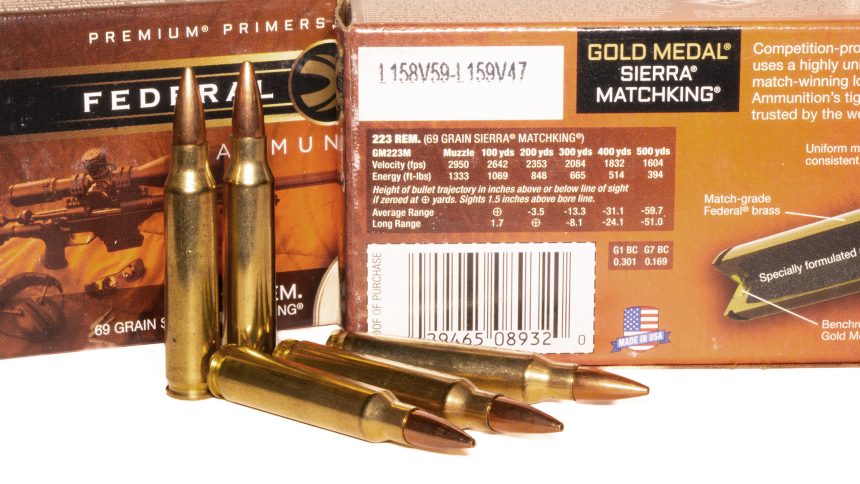

With most commercial ammunition, the lot number isn’t that important—unless you have a problem, or find a batch that works especially well and you want to buy more of it.
There is a lot of information on a box of ammunition. The first thing we all look at is the cartridge designation, because we want to know if the ammo in the box will work in our gun. Next, we look at the bullet weight and type so we will know if the ammo is compatible with what we want to use it for. But, there is some other info on a box of ammo. It’s called the lot number, and I bet many shooters don’t know what this number is for, what it means or maybe even where to find it.
If you’re a handloader, you will understand perfectly the purpose of a lot number. When you handload ammunition, you keep detailed notes about all the components you use and the physical dimensions of the ammo you create. You’ll also make notes about velocity and precision in the gun(s) for which you loaded the ammo. This is so that when you find a handload you like, you can duplicate it later. This is one of the reasons ammunition manufacturers use lot numbers. They want to know every specific of every load they sell, but not just so they can duplicate it later. They also want this information in case there’s a problem down the road.
Let’s say you purchase a box of ammo for your 9 mm pistol, and while you’re shooting, you have a case-head separation. A case-head separation can potentially damage a gun—especially a rifle—and can also potentially injure a shooter. Back in the 1990s, I saw this happen multiple times with Glocks chambered in .40 S&W. On one occasion, one of the officers on my range received some minor injuries. When an ammunition manufacturer is made aware of an issue like this, it can consult the information associated with the lot number of the load that was fired and see all the particulars of that load to include pressure-test data.
The problem might not be dangerous, though. It could be that a manufacturer is getting multiple reports that a certain ammunition is not feeding and functioning correctly in certain firearms. For example, ammunition used in AR-15s—direct-gas-impingement-driven guns—needs to produce a certain port pressure for the gun to function and cycle properly. It could be that the components used in a certain load are not providing the requisite port pressure. It also might be that the rim on the brass case is out of spec. This was something often seen during the last ammo shortage we experienced. In either case, with the lot-number information, a manufacturer can better investigate the problem.
But, lot-number information can be valuable to you as a shooter, too. Some years back I received some 6.5 PRC ammunition from a manufacturer, and it shot great in my rifle. Recently I ordered some more of that ammunition, and it did not shoot as well. The new ammo was from a different lot number, but why the difference? Well, it could be a lot of things. The manufacturer may have started using a different powder or primer for that load, and my rifle just did not like the combination. It could also be that the bullet manufacturer slightly tweaked the projectile’s design. This happens sometimes, too.
As an example of bullet tweaking, not too long after Berger began marketing its VLD bullets for hunting, some competitive-shooting customers were complaining that the bullets had striation marks near the bullet nose (they wanted their bullets to be pretty). Berger found that by slightly increasing the lube in the forming die, these striations disappeared. The problem was that this extra lube slightly changed the dynamics of the bullet by increasing the strength of the jacket, and the “pretty” bullets would not expand/upset the way hunters wanted them to. Berger discovered this because hunters were complaining about them. The company sorted this out by making the bullets both ways; it just put the hunting bullets in orange instead of yellow boxes.
The good news is that if you are just buying ammunition for plinking or recreational use, the lot number is not that important. However, if you are seriously interested in the best precision possible, it’s a good idea to note the lot number of any load you try. This will allow you to go back to where you bought the box of ammo you wanted to test and buy a lot more of the exact same load. Lot numbers are not just on individual boxes of ammunition; they also appear on case boxes. Long-range shooters routinely buy in bulk like this to ensure they can deliver accurate shots at extreme range, just exactly like they would if they were handloading their own ammunition.
I talked with Federal Ammunition about its lot numbers. When the company creates a load for any cartridge, it records all the pertinent information about that load, including the pressure-testing and accuracy results, then assigns a lot number to every box. When Nosler makes bullets, it also uses a lot number, and not only are these bullets tested for precision, but the company also tests its hunting bullets for upset/expansion at various velocities, and the test bullets are retained for record. Similar procedures are exercised by most other major ammunition, bullet, powder and primer manufacturers. So, this means if you’re a handloader, you need to record not just the specifics of the load you create, you also need to record the lot number for every component you use.
Now that you know what a lot number is for, you need to know where to find it. With most of the ammunition that’s loaded in cardboard boxes, you’ll find the lot number stamped on the inside of the flap. With some manufacturers, you may see the word “Lot” included in the number stamp. You might also see some other information—printed as opposed to stamped—on the flap, and this information might be the load or even the packaging identifier. With plastic ammo boxes like Federal uses for some handgun loads, you’ll find a rectangular white section in the labeling where they stamp the lot number, or it will be stamped on the plastic box itself. With most of the ammo Hornady manufacturers, the company includes the lot number as part of the printed label.
For most shooters, the lot number is something they won’t need to worry about. But, if you are particular about how your ammo performs, and if you want to ensure it will continue to perform the same way, you might want to pay attention to the lot number and buy a lot of the lot you want.
Read the full article here