


The shotgun’s weakness is twofold: First, it doesn’t hold many rounds; and second, it’s slow to reload. But, with the proper setup, techniques and practice, these weaknesses can be mitigated. Here’s how to do it:
As a quick caveat, I realize that there are non-traditional shotguns available these days that hold lots of rounds, while a few others are easy to load: KelTec’s bullpup KSG holds 14 rounds, for example, while Mossberg’s detachable-mag-fed 590M series loads quickly—but I’m talking about the more traditional, tubular-magazine, pump- and semi-automatic models that represent the majority of those found in homes across the nation. Most of these hold five rounds, eight if they wear a mag extension. Hopefully, those shots will be all the home defender needs to end the threat, but I wouldn’t bank on it. I think it’s a smart idea to be prepared to reload at least once.
The first key to minimizing risk while pausing to reload is to never let the shotgun go completely empty. Throughout the course of history, plenty of good people have been compromised the moment their gun ran out of ammo and the attacker realized it. So, at any opportunity the mag should be topped off so that the home defender always has at least one round in the gun, ready to fire.
Many different methods can be employed to get your defensive shotgun back in the fight, but all require quality instruction and copious practice to perfect.
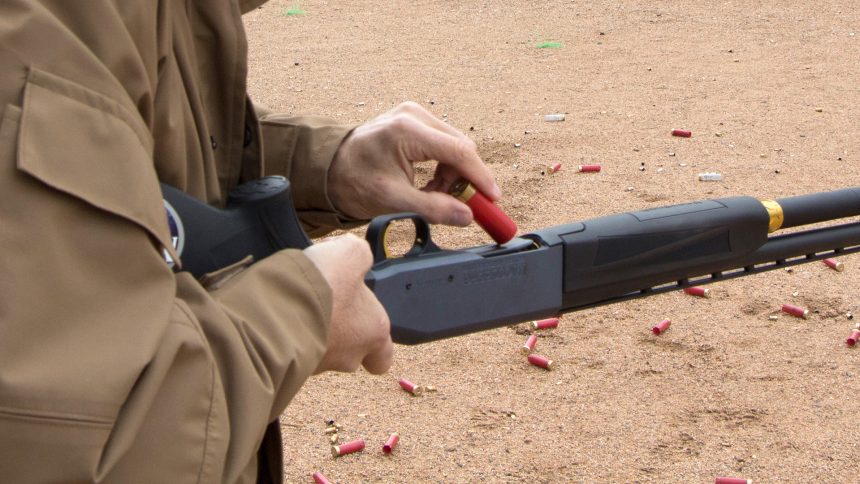
But, sometimes topping off is not feasible and the gun does run dry. In this case, the first shell should be “emergency loaded” into the chamber so the gun can be re-engaged into the fight as quickly as possible, while the mag can be filled as the situation allows. An emergency reload simply means that a shell is hastily grabbed (with either hand, but I’ll get to this later) and shoved into the open receiver and moved into battery via the pump action or bolt-release button as fast as possible. Essentially, this is a single-shot reload, but it needs to be contemplated and practiced for maximum efficiency.
The most efficient way to top off a magazine or perform an emergency reload is with the use of a shell holder—or shell caddy—preferably on your shotgun, or, if not, on your belt. Shell caddies either stick on or are bolted to the receiver of the shotgun, but I’ve found that the stick-on kind often doesn’t stick after a year or so in the closet. Of course, you can keep a bandolier of shells at the ready, same as a shell holder that clips on your belt, but most experts believe that if something goes bump in the middle of the night and all hell breaks loose, you’ll be doing good to get to your shotgun and your cell phone, much less have the time and wherewithal to gear up for battle. Therefore, it’s a good idea to store extra rounds on the gun itself. (Some slings contain shell loops for shells, but I don’t prefer them because it’s tough to hold the shotgun on target with a shell-laden sling swinging back and forth. Try it and you’ll see what I mean.) Once you figure out what type of shell holder works best for you—maybe it’s a simple belt pouch or even a robe pocket—then you can practice the most efficient technique of reloading from it.
Perhaps the most efficient method of top-off reloading is for shooters who are strong enough to hold their shotgun to the shoulder with only the strong (trigger) hand. With the shotgun pointed forward in the firing position, the weak hand can reach to the shell caddy, the belt or a support-side pocket, find a shell and insert it into the magazine with the thumb and forefinger—all while never taking the eyes off the target. For those who cannot hold their shotgun at the ready with only the trigger hand, they can either place the buttstock under their armpit while turning the magazine loading port toward the off-hand, or they can turn the gun upside down while resting the butt on their hip—all while the trigger hand stays on the grip. Either way, the weak hand should find a shell and insert it. Expert shooters can reach for two or even four shells at a time, orient them in the support hand without looking and feed them into the magazine without having to go back to the shell carrier each time, but such a technique is inadvisable without years of competitive training and practice.
If your weak hand is pretty much worthless—or if your gun of choice is a pump (because a pump’s action must be worked with the support hand, there’s a strong argument for always keeping the support hand on the fore-end of a pump)—the shooter has a few options for efficient reloading. To top off the mag, the shooter should secure the shotgun to the shoulder in the firing position with rearward force provided by the support hand. Then the strong hand should come off the grip to grab a shell and stuff it in the magazine from underneath. For multiple reloads in succession, the shooter can flip the gun upside down and place it on his or her shoulder, almost like a violin. Then, using the strong hand, a shell or shells are plucked from a shell holder, oriented and stuffed into the magazine as quickly as possible before sliding the action into battery with the weak hand and flipping the gun right-side up and reassuming the shooting position.
After these techniques are learned with your specific shotgun and ammo setup, they should be rehearsed until reloading becomes second nature, even in the dark and, preferably, while moving. Strongly consider buying (or making) dummy loads so practice can be performed in the comfort of your living room.
Read the full article here