


Carrying a 1911 in Condition Two—half-cocked—is both impractical and far less safe to reach than either Condition One or Condition Three, both of which clearly provide greater readiness and safety.
Several of my gun friends were having a discussion regarding the various safe ways to carry a 1911-style pistol. We all agreed that cocked and locked—Condition One—was the predominantly preferred method. However, where we disagreed was concerning Condition Two, which is where the pistol is carried with a loaded chamber and the hammer in the half-cock position. One side of the argument was that having the hammer in the half-cock position made the gun impossible to fire, and that it was just as easy to thumb back the hammer as it was to release the thumb safety when making the pistol ready to fire. The opposing side contended that the 1911 could fire from the half-cock position, and that it was dangerous to lower the hammer and carry the gun in that condition. One member in this group said that he had witnessed a 1911 firing from half cock and was convinced that carrying a 1911 in such a manner was an accident waiting to happen. Our questions are: Is it safe to carry a round in the chamber of a 1911 in Condition Two, and is it possible to fire a chambered cartridge with the reduced hammer fall from the half-cock position?
Anonymous, via e-mail
There are two predominant ways of safely carrying a 1911-style pistol. Condition One, also known as “cocked and locked” with the hammer cocked and the thumb safety engaged, is preferred by law enforcement and most serious operators of the 1911. When the 1911A1 was in service with the U.S. Military, the primary method of carry was Condition Three, which consisted of lowering the hammer on an empty chamber by pulling the trigger after the pistol had been inspected clear and empty, then inserting a loaded magazine in the magazine well to load the gun. With no round in the chamber, it was impossible to fire the gun until it had been drawn and the slide had been retracted and released to chamber a round, readying the pistol to fire. The thumb safety was not and could not be used with the hammer down in Condition Three.
To get a 1911-style pistol into Condition Two requires extreme caution in that the trigger is being pulled with the thumb safety as well as the grip safety disengaged and a live round in the chamber, while the hammer is being gently lowered with a finger, the thumb or both. For some, the coordinated effort of pulling the trigger and safely lowering the hammer can be challenging at best.
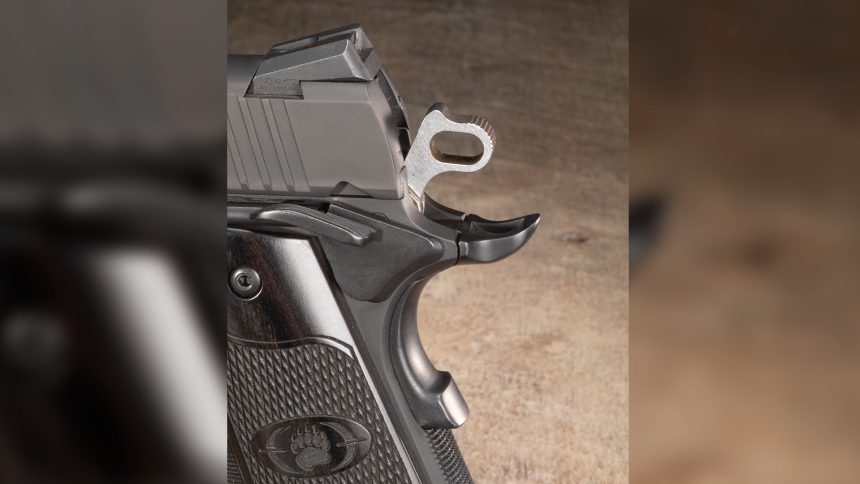
While there is a recess in the half-cock notch of 1911A1-style pistols to capture the nose of the sear, this does not always end up as intended. Since it is necessary to pull the trigger to release the hammer forward from the cocked position while controlling the hammer under the pressure of the mainspring, coordinating those two actions can result in the sear unintentionally resting on the forward edge of the half-cock notch and not in the recess of the notch. This condition results in the hammer forward as intended, but not locked in place. So, when the trigger is pulled or the gun is inadvertently jarred, the hammer will fall forward off its perch and hit the firing pin.
The distance the hammer travels from half cock is occasionally sufficient to indent the primer and subsequently fire the chambered round. The weight of the inertial firing pin and the strength of the firing-pin spring—as well as the hardness of the primer of the chambered cartridge—all have contributing impact on whether the hammer blow from the half-cock notch will ignite the round in the chamber or not.
In my opinion, if operational readiness is the primary concern, Condition One is the best method of carry for a 1911-style pistol. However, if safety supersedes operational readiness when carrying a 1911-style pistol, Condition Three optimizes that objective.
Condition Two violates the three accepted times that the trigger on any firearm should be pulled: live fire, dry fire and for checking its function.
Carrying the 1911 with the hammer in the half-cock position—Condition Two—offers no advantage beyond Condition One or that of Condition Three and is not recommended because there is a real possibility of the 1911 pistol going off half cocked.
Read the full article here