



DPP, RMSc, RMR, ACRO, and Doctor Optics: all similar but different red dot footprints. Are you confused yet? The world of optics footprints is messy and confusing. The naming conventions sometimes overlap, also adding to the quagmire. In this article, we’ll sort through it all to provide a clear answer as to why each exists. Hopefully, you’ll be less confused by the end.
While I won’t delve into the history of red dots on pistols, numerous quality articles are available from individuals who have experienced it firsthand. However, the practice gained traction in the 1980s and 1990s in the competitive arena.
Red Dots on Pistols Background
Back then, the optics were quite different from what they are now. Fast-forward to 2009: Trijicon introduced the Ruggedized Miniature Reflex (RMR). Originally designed to piggyback on the ACOG, the RMR was effectively the first micro red dot to gain widespread popularity and general use in the United States. The optic’s ruggedness allowed it to be mounted directly on the slide, rather than on the frame of a handgun (as with earlier competition guns). Unlike previous examples, the RMR could handle the impact of a reciprocating slide.
That led to one main problem: how do you mount a red dot to a pistol slide? Early on, one of the largest service providers was ATEi. As popularity grew, especially in law enforcement and military circles, more gunsmiths emerged to provide optics-cutting services.
From there, it was a tidal wave. More civilian shooters gravitated to pistol-mounted red dots. Manufacturers responded by offering pistols with factory optic cuts. That, in turn, led to the rise of more optic brands producing micro red dots for pistols.
And now, in 2025, optic cuts on pistols have become a standard feature. Fortunately, pistols like the Springfield Echelon can easily be adapted to a variety of optic footprints thanks to its Variable Interface System (to learn more, click here). But that system’s very adaptability raises the question: why do so many footprints exist?
The RMR
Due to the RMR’s proliferation, it has become a popular choice for optic manufacturers to model their optics after. However, this optics geometry was somewhat limiting. Early models were battery-free and used the same Tritium technology as on the company’s ACOG. Later, battery-powered options were issued. However, due to the optic’s compactness, the battery compartment was at the bottom and not enclosed. Once the optic was attached, the slide held the battery in place.
The RMR footprint uses two post lugs at the front and 18.8mm spacing between screw holes. Outside of Trijicon, optics from Holosun and Swampfox share the footprint. Holosun, for example, uses smaller CR1632 batteries instead of the more powerful CR2032. Often, Holosun provides solar to help supplement the smaller battery.
Docter/Noblex
Today, the Docter optic footprint remains popular due to compatibility with models such as the Vortex Viper and Burris Fastfire Enclosed. This footprint uses two screws and four posts to secure the optic.
Docter Optics is a German company with roots dating back to Carl Zeiss Jena. Docter was one of the original developers and innovators of red dot pistol sights, with the footprint dating back to 1998. Its international popularity led many manufacturers, such as Vortex and Burris, to adopt it as a standard. Although it isn’t nearly as popular among American manufacturers today, it remains common in Europe. Purchased by Noblex in 2018, the company remains a leading European manufacturer of sports optics.
Springfield offers an adapter plate for the Docter footprint for the Echelon.
DeltaPoint Pro (DPP)
While the Delta Point Pro wasn’t Leupold’s first attempt at a micro red dot, it was the one that really stuck with shooters. Introduced in 2015, the DeltaPoint Pro was developed in response to customer feedback. The original press release stated: “The DeltaPoint Pro was built with the warfighter, backcountry hunter, and defensive pistols in mind. For these folks, a sight problem can mean more than a bad score on a pistol stage.”
Compared to the RMR, the DPP has a narrower base with a 14mm screw hole spacing, making it better suited for pistols with narrower slides, such as single- and double-stack 1911’s. Many optic manufacturers have widely adopted the footprint’s design. I believe its rise in popularity is mainly due to this; its dimensions allow manufacturers more flexibility with screw holes and battery placement.
Shield RMSc
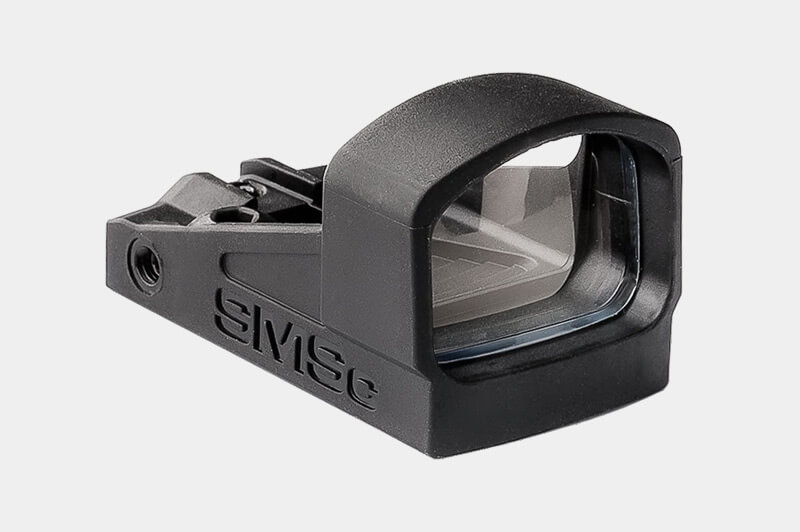
While large-frame pistols use a variety of footprints, modern slimline pistols have mostly standardized. The RMSc optic, developed by Shield Sights to work with its compact red dot models, was among the first to offer a red dot for these types of pistols. The rise of slimline pistols necessitated a compatible optic, with Shield being the first to offer one. It is also shared by optics like the Viridian RFX11.
In my experience, the screw hole pattern stays consistent at 14mm on these optics; however, some models use two lugs instead of four, which can cause complications. For example, Holosun uses two lugs. Many manufacturers keep the four-lug pattern as standard for RMSc footprints.
ACRO
The Aimpoint ACRO was introduced to address several issues with modern red-dot pistol optics. Traditional optics employ an open-emitter design. These optics can accumulate dirt, lint, and other debris that can block the emitter. They can also be vulnerable to rain.
The ACRO, being an enclosed-emitter optic, is generally considered more durable. It was developed for military and law enforcement agencies that require maximum ruggedness and reliability in the harshest environments. Since the optic is fully enclosed and has no exposed screw holes, a new mounting pattern was created.
Aimpoint developed a rail-clamp-style interface featuring side grooves/lugs, a single horizontal clamp screw, and a recoil lug that engages the firearm or adapter interface. The ACRO footprint has become common for manufacturers offering similar designs, such as Steiner with the MPS, and Gideon Optics with the Mediator II.
Holosun even has a similar optic, the 509T, which mimics the ACRO’s functionality but uses a different rail-clamp footprint; such is the joy of optic ownership.
Springfield offers an Echelon adapter plate for the ACRO footprint.
Adoption of Red Dot Footprints
The footprints listed above are likely the ones you’ll encounter in 2025. Yes, there are others, such as the C-More and RMRcc, but they aren’t as widely used. While optic manufacturers have developed various patterns and footprints, it’s up to the firearm maker to adapt them.
So far, the best system I’ve used is the Springfield Variable Interface System, which I noted earlier. This system uses sets of self-locking pins to fit the patterns of a wide range of popular red dots. VIS is designed to work directly with the Trijicon RMR, Leupold DeltaPoint Pro, and Shield RMSc footprints (and all the related matching footprint optics). However, as noted, Springfield also offers plate systems for the Aimpoint ACRO and Docter footprints, which require a larger footprint area.
The pins are designed to, when properly installed and the optic is tightened to the correct torque specification, push outward within the optic’s locating holes with just enough force to hold it securely in place against side-to-side movement. This system addresses multiple issues at once, and (apart from the ACRO and Docter footprints) does not require plates and the optic is at the lowest bore height possible.
Zooming Out
If you feel mentally exhausted after reading this, I understand. The world of pistol-mounted optics has long been a problem without a solution. The issues: everyone has tried to develop a solution, resulting in multiple footprints that frustrate millions of owners worldwide. Fortunately, we are entering an era where some standardization is beginning to take hold. The RMR, DPP, and RMSc footprints have gained the most popularity, with the ACRO emerging as a popular alternative.
New optics, such as the Vortex Defender-ST and CCW Enclosed Solar Micro Red Dot, incorporate some of the best features. To help shooters further, Vortex offers a variety of screws compatible with the most popular pistols — more optic manufacturers should follow this example.
Firearm manufacturers need to keep finding ways to make life easier for gun owners (like Springfield did with the Variable Interface System for the Echelon), and investing time and money to adapt an optic to a handgun should no longer be a frustrating task.
Editor’s Note: Please be sure to check out The Armory Life Forum, where you can comment about our daily articles, as well as just talk guns and gear. Click the “Go To Forum Thread” link below to jump in and discuss this article and much more!
Join the Discussion
Featured in this article




Read the full article here